(CNN) Russian diplomat found dead on street outside Berlin embassy

(CNN) Russian diplomat found dead on street outside Berlin embassy. Quoting,

The death of the diplomat came nearly a year after an investigation by CNN and Bellingcat revealed that an FSB toxins team of about six to 10 agents trailed Russian opposition leader Alexey Navalny for more than three years before he was poisoned in August 2020 with the lethal nerve agent Novichok.

An excellent factual summary: (Bellingcat) Russian Diplomat Who Died at Berlin Embassy is Senior Intelligence Figure’s Son

Limited by policy typical of reputable news organizations, CNN does not directly speculate that the diplomat/spy was executed. With the understanding that what follows is speculation informed by precedent, we can be more direct.

With the notable exceptions of Vitaly Yurchenko and Oleg Gordievsky,  the sanction for Soviet/Russian nationals guilty of treason has been death. Yurchenko escaped punishment because his cover story had propaganda value that would have been destroyed by disclosure he had been an ambivalent traitor.

Gordievsky, a double agent, ultimately escaped punishment with exfiltration by British intelligence. (Haaretz) How Double Agent Oleg Gordievsky Changed the Course of History.

Gordievsky’s survival had another factor. Perhaps in response to the horrors of the Stalin era, the post-Stalin KGB developed a standard of internal adjudication with some of the protections customary in the West. The KGB did not prejudge traitors in their ranks. In 1985, in an informal weekend retreat, Gordievsky was interrogated with remarkably effective truth drugs. As the drugs produce complete amnesia, Gordievsky himself would not have known what he said. As his personality is controlled rather than impulsive, it is possible he did not reveal enough for conviction by then prevailing KGB standards . He was blacklisted, set free, then exfiltrated.

During the Stalin era, many executions occurred in the offices of superiors; post-Stalin, with more formalized adjudication, in prisons. There was little need to terminate a double agent in the target country; the double remained tied to the motherland by cultural distance from the West, with family held hostage to loyalty.  Soviet tradecraft was excellent, which meant that  a Soviet double had the skills to avoid detection until fingered by a U.S. double, such as Aldrich Ames.

This skill also resulted in lack of awareness by the double that he had been fingered. He would simply be called back to Moscow on pretext, subjected to a trial/interrogation which obtained the important “confesssion”, and legally executed. Now that tradecraft has crumbled, there is a reasonable possibility a double knows he has been detected, and will bolt, escaping punishment.

Bellingcat:

…the diplomat was the son of the deputy director of FSB’s Second Service and the head of the FSB’s Directorate for Protection of Constitutional Order, Gen. Alexey Zhalo. …As previously reported by Bellingcat and its partners, the FSB’s Second Service has been linked to the assassination of Georgian asylum seeker…

It is natural to wonder if the son was in the same line of work as his father. While nepotism remains strong, and the post would have formerly  been part of the nomenklatura, this is unlikely.  Germany is sufficiently porous there would be no need to cloak “assassin supporting services” with diplomatic cover.

His real  job, with cover of  “second secretary”, likely involved contact and recruitment in the German government. He may have decided to go double. Sadly for him, Germany is so permeated with Russian spies that the person he approached may have been an agent for Russia, who fingered him.

Why did the Russians not call him back to Moscow on pretext?

  • He could have known he was fingered, the consequence of poor compartmentalization — tradecraft.
  • He could have been warned by his father.
  • His father could have assented, to avoid the stain.
  • He could have been acting for his father, as a conduit to the West.

Hence the necessity of execution on embassy premises, before he could bolt. Watch for the untimely demise of Gen. Alexey Zhalo.

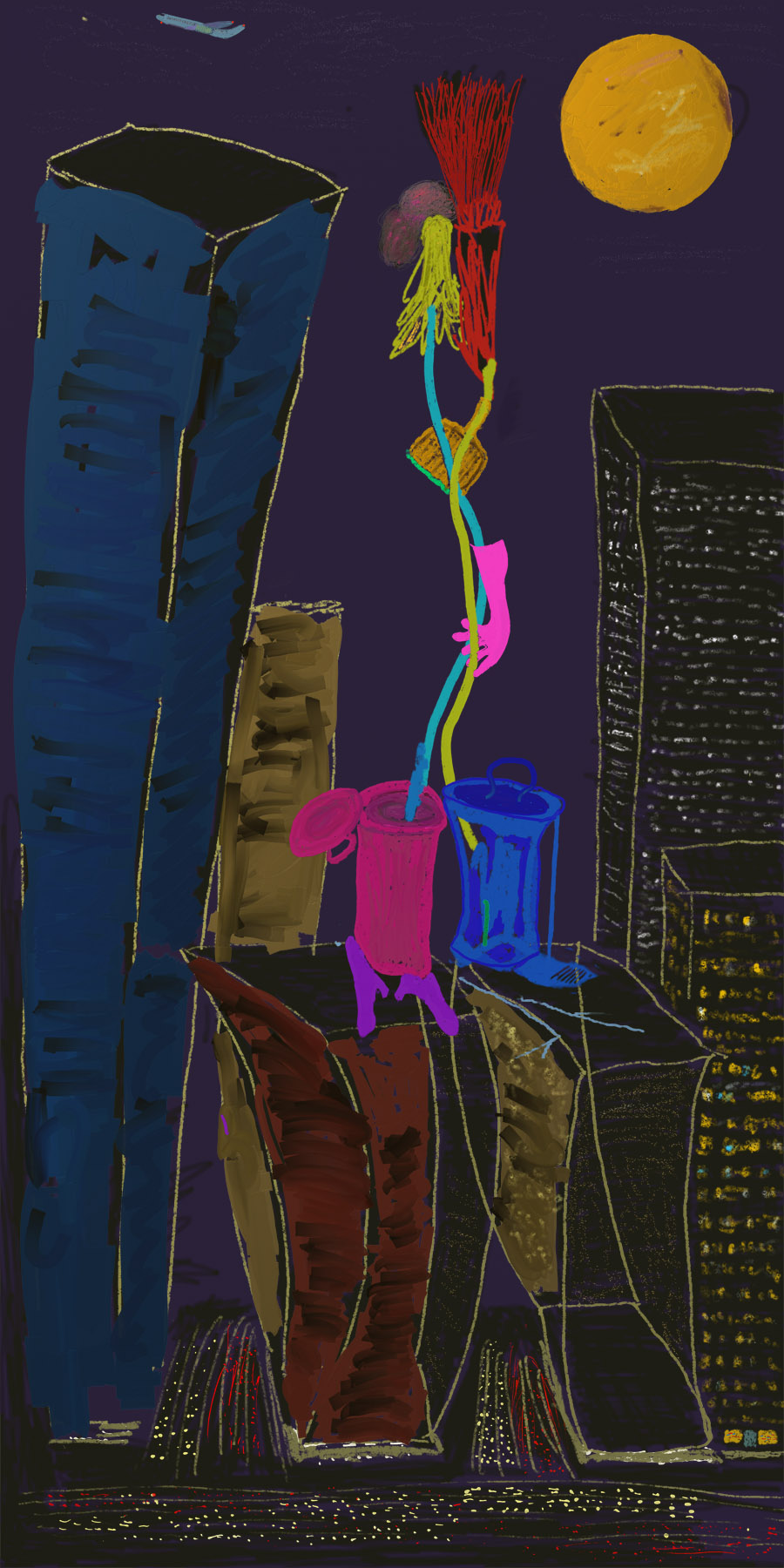


Halloween: Mop and Broom Night out

Mop and Broom Night out

Once a year, on Halloween eve,  Mop and Broom, who live in a janitorial closet, escape for a glorious night out under the stars on a Manhattan rooftop. Both have preened themselves –  Mop has adorned with fresh Brillo pads, while Broom has combed out his straw.

At the stroke of midnight, under the spell of their lowly lives, they return to their closet to live in darkness another year. This time may be different. They are plotting their escape.  (Read down.)

(Click to enlarge.)

Will they succeed? Check back in the wee hours of this night. Hint: When  they flee, the moon must be at apex.

(CNN) Senior US general warns China’s military progress is ‘stunning’ as US is hampered by ‘brutal’ bureaucracy; China’s Hypersonic Test; Your Chance to Win $1,000,000

(CNN) Senior US general warns China’s military progress is ‘stunning’ as US is hampered by ‘brutal’ bureaucracy. Several considerations:

  • Bureaucracy
  • Artisanal space hardware
  • Secret Equations
Bureaucracy

Yes, it is brutal.  In one small company, there were four workers,two principals, and one person whose specialty, with arduous academic training, was “managing” a DoD project. That’s 43% overhead. Yet they couldn’t figure out how to buy a $30 book I needed, so I bought it myself.

DoD is hard on big companies too.  In the same epoch, salaried management at Lockheed-Martin were required to attend interminable after-hours meetings with the brass. At these meetings it was understood that even if their presence wasn’t topical, they had to show face — at the cost of a decent life, family, and sleep.

(CNN)Member of CIA chief’s team reported Havana syndrome symptoms on recent trip to India describes a  $5 instrument that, had it been deployed, would have made a big contribution to solving the riddle. Someone close to the problem may have thought of it, deterred by the project overhead of something so  intrinsically cheap.

Some programs under DoD management nevertheless get away with murder. The Littoral combat ship program is marked by instances of what some might call fraud, such as fixes to the propulsion systems without telling the Navy what those fixes were. DoD management requirements drowned management in paper, inviting fraud instead of preventing it. Six ships, with an average age of only 8 years, LCS-1, LCS-2, LCS-3, LCS-4, LCS-7, and LCS-9  have been or will be decommissioned as unserviceable. This is not William Proxmire’s $600 toilet seat. What did all that onerous bureaucracy buy the taxpayer?

So DoD bureaucracy cuts both ways. To address General Hyten’s concern, we need a compact goal. So here’s a proposition:

  • Establish a class of project that can be managed by a competent manager who has not received a special education in DoD projects.
  • Insulate the class from  DoD intrusion of the onerous kind. Replace short review intervals with longer ones, and trust (see below.)
  • It will probably involve research and prototyping, not large scale production.
  • Depending upon the outcome, that manager receives a “trust rating” that facilitates further management opportunities.
  • Skunk Works may provide some inspiration.
Artisanal Space Hardware

Quoting  CNN,

Hyten pointed to the development of hypersonic weapons to highlight the stark difference in approaches by the US and China. He said the US has carried out nine hypersonic tests in around the last five years while the “Chinese have done hundreds.”

It is concerning, though the blow softens when we consider that the U.S. approach to hardware has always been artisanal, relying on finely crafted rockets, sparse, slow rate test shots, and detailed telemetry to get as much data as possible from those shots. In contrast, at least some of the numerous China shots appeared to have very primitive telemetry.

If hundreds of tests are the way to go, a cheap, non-artisanal booster is needed. U.S. rockets are artisanal for a reason: to get the biggest boost with reliability appropriate to the payload, in a process of extremely violent, yet controlled combustion. Though printed parts present new possibilities, a  non-artisanal booster that is safe to be around is not a small job.

Secret Equations

Although secret equations are usually found in grade B movies, they may actually exist. The public version has a big name,  Navier-Stokes.  And they have a big problem. Other than a few special cases, nobody knows if they have solutions. And they are critical to design of hypersonic bodies. The Clay Institute offers a $1M prize if you can prove they do or they don’t.

Paradox: Even though nobody knows if they have solutions, they are used in computer simulation of hypersonic flight. The sims give solutions, the equations do not, so what gives? It turns out that the sims blow up, go to infinity,  unless the numbers are massaged. This is quicksand.

A while back,  a Chinese graduate student in Beijing managed to simulate Navier-Stokes on a primitive  AMD parallel processing platform called Close to Metal. This was very impressive, since successful use of CTM, which had no debugging facilities, was very rare.

Navier-Stokes brings the most powerful supercomputers to their knees, so slow they seem like last year’s smartphone. This is why test shots are so important. There has been some progress; some people in the Netherlands figured out how to make the sims more efficient.

What if the Chinese have solved the Clay Institute Millennium Challenge? The solution could enable simulations that run more efficiently and accurately. As with the U.S. nuclear capability, it could eventually result in the ability to design a hypersonic body with minimal testing.

Good hunting, gentlemen.


COVID Winter Predictions; Delta+/AY.4.2; Prediction Follies, Part 1

We’re going to undermine. Grab your shovel so we can dig under the modeling establishment.

(NPR 10/21) People wonder if they should keep calm and carry on in the face of delta plus variant,  and

(NPR 9/21) Is The Worst Over? Models Predict A Steady Decline In COVID Cases Through March. This is the product of the COVID-19 Scenario Modeling Hub, who apply techniques of data fusion to provide hopefully better predictions than any one study. As of 11/23/21,  their predictions of cases/week for 3/05/21 are:

  • Childhood Vaccination, No Variant: 63,383.61,  approx 9000/day
  • No Childhood Vaccination, No Variant: 87,682.39, approx 12500/day
  • Childhood Vaccination, New Variant: 329,215.58, approx 40,000/day
  • No Childhood Vaccination, New Variant: 467,507.85, approx 67,000 day.

Numbers like 63,383.61, implying accuracy in great excess of actual, would dock a student points in a physics exam.  These are not real numbers; two digits of precision are more than enough. Let’s call it a culture clash.

This is one of those occasions where it is constructive to undermine. To allow the predictions to remain unchallenged invites possible public health whiplash, as happened with (CNN, 2021/05/14) The CDC says masks are no longer needed inside or out if you’re fully vaccinated. By now, we should realize that COVID has more fake-out moves than the Harlem Globetrotters.

The predictive techniques of epidemiology were developed, tested, and refined on familiar diseases:

  • Formerly endemic diseases of childhood: measles, mumps, chickenpox,  pertussis, diphtheria, polio.
  • Epidemic/endemic respiratory infections, primarily influenza, which has  known rhythms spanning decades.
  • Tuberculosis, which remains a slow moving, almost silent, almost indolent scourge of mankind, with prediction  horizons of years, not weeks or months.
  • Sexually transmitted diseases, formerly called “social diseases”: syphilis, chlamydia, HIV/AIDS.
  • Endemic common cold, caused by multiple  virus families, 200 viruses in total.

The prediction problem for each of the above has a defining feature:

  • Childhood diseases. Before COVID, throughout the U.S., the environment of elementary public school education  changed little year-on-year. U.S. children experienced an environment homogeneous compared to adults. Hence measles R_o is a stable number.
  • Influenza is far more livable than COVID. Except for 1918, epidemics and pandemics have not caused large scale behavior modification.  The defining feature is resemblance of prevailing strains to previous ones.  This single feature is enough to make prediction accuracy poor.
  • New tuberculosis infections occur in about 1% of the world population/year. This means that, except for clusters with special features, such as prisons, prediction can be as simple as extrapolation.
  • Sexually transmitted diseases, in the U.S. with  a few exceptions, have a single voluntary factor. This makes them amenable to sociological study.
  • The endemic common cold, predictably present, is the future of COVID. The arrival of that future cannot be predicted.

Chaos. These simplicities are missing with COVID, which modifies individual behavior unpredictably; people wear masks or don’t, go to parties and bars, or don’t; take off their masks to chat, or don’t; hide in their abodes or eat out. They adhere, scoff, and change their minds. They respond to the weather, the season, holiday, or what their guru or political god, or media told them to do. They veer between fear,  confidence, and affront.  With this variation, the Black Swan event is the norm. Steady-as-you go is rare.

Before COVID, how close did you stand while conversing? From Culture Crossing Guide, Israel:

Israelis usually stand close to one another while talking. One to two feet is normal. It can be considered rude to back up or away from someone while they are speaking. People speak at closer than an arms distance. They may touch while speaking,

Personal space by country: (WAPO) What ‘personal space’ looks like around the world.  Culture counts.

If a vaccine is, say, 95% effective in a culture with one assumption of personal space, can it be assumed to be as effective with a smaller space? Quoting from (CNN) Boo-Boo: How safe is it for vaccinated people to return to in-person work? An expert weighs in,

  • Type A: 8 college students jammed into a payphone booth. Everybody in every group gets Delta.
  • Type B: 8 employees doing phone sales out of a 10×10 room in a converted residence. 9 out of 10 Type B groups (small room)  get 6 or more Delta cases.
  • Type C:  Skeleton crew of 8 in a large ventilated newsroom with forced air HEPA filtration. 3 out of 10 Type C groups (newsroom) get 3 or more Delta cases.

Personal space equates to proximity, which relates to exposure threshold in a way not known with any precision. Now suppose, unknown to  disease modelers, our personal space has expanded with social distancing. Since this opposes cultural tradition, it will reverse, around Thanksgiving, Christmas, New Year, and whenever the present looks bright. Israelis, with their close conviviality, may have given us a glimpse: (CNBC) Israel doubles down on booster shots as daily Covid cases set new record.

Waning immunity may not be the whole story; it may combine with dynamically changing, culturally mediated exposure to cause vaccine failure.

Takeaway: COVID-19 is a unique combination of airborne transmission and social factors that have resulted in:

  • Modeling errors, due to complex social factors, that are impossible to rectify.
  • Chaos, where the Black Swan drives the epidemic, yet defies statistics.
  • Models which have no track records beyond very short time horizons.
  • Delta+/AY.4.2 left as a question, which should tell you something: We have to see what it does before we can tell you what it will do.

Next, a little napkin calculation.


Colin Powell; What Makes America Great?

(CNN) Colin Powell, first Black US secretary of state, dies of Covid-19 complications amid cancer battle.

America’s greatness is measured in great individuals. When they are occasionally in possession of the public trust, together we touch greatness. Colin Powell was one of them. At times, greatness is embodied in the unshakable resolve of a Washington or Lincoln. Colin Powell’s greatness was of another, more subtle kind.

Powell considered himself a principled custodian of the public trust. When he realized he had betrayed that trust, he owned up to it, which resulted in his dismissal as Secretary of State. But the bar to great leadership  is higher than simple sacrifice. It requires effectiveness. Powell realized that consensus is crucial to democracy, and compromise is crucial to consensus.

If he had been asked, “Who owns the dream?” I think he would have replied, “No one. And everyone.”   To those who think they own the dream of America, look to Colin Powell.

Lead on, Colin Powell.


(CNN) Prince William slams space tourism and says billionaires should focus on saving Earth

(CNN) Prince William slams space tourism and says billionaires should focus on saving Earth.

Bravo, Prince William! Space tourism is an ego trip; a hyper-expensive view out a window, well mimicked in virtual reality – except for the chance of an exotic death.

Carbon based life is unsuited for space exploration. Androids, resistant to radiation, who will not require air-water-food life support systems, will take our places.  Androids will have the ability to experience, and relate experience, which is the only thing robots currently cannot provide. And they are expendable.

Until this rapidly approaching future, the extreme cost of manned space flight should be reserved for more than flights of fancy. The Tsiolkovsky/Goddard rocket equation enforces a huge carbon cost, with no solution on the technological horizon. This severely circumscribes the economic exploitation of space.

Freed by androids of the huge incremental carbon-cost burden of life support, some small subset of hopes for economic exploitation may be viable.

Or maybe not. The odds favor Prince William.

US intelligence community UFO report; Steam Powered UFOs; Getting Metaphysical, Part 3

We continue from

In Part 2, which advances the Chinese drone hypothesis, I cautioned, “Whether or not this explanation approaches correctness, it has an important purpose. It must be thoroughly disposed of before moving against Occam’s Razor, further down the list.” Perhaps I should have explicitly addressed sightings of something resembling a submarine at  periscope depth. An entity which can field UFOs of such amazing ability would hardly need submarines, nor enjoy the corrosion of salt water.  Which is easier to envision:

  • An intelligence failure relating to submarines and drones circa 2003?
  • Physics so far out of the box, we haven’t a clue?

Let’s assume that the Chinese drone hypothesis has been hammered on and deprecated. We would want to pipe-dream some ideas and make a category list:

  • Within the state of the art.
  • Impractical.
  • Not within the state of the art, but someone is  spending money on it.
  • Has been observed at large scale in the universe, but not on the scale of human engineering.
  • Allowed by theory, or thought to be. This is frequently a mistake of naive interpretation.
  • Metaphysical, informed speculations on aspects of the universe not accessible to us.

All of these, except for the last, involve energy. The concept of energy as a thing dates to 1740 due to a brilliant French woman, Émilie du Châtelet, doubtless inspired by Isaac Newton and  the 1712 steam engine of Thomas Newcomen. Development of James Watt’s improved engine began in 1763, so du Châtelet was a true visionary.

Steam engines were used to do work, the expression referring to the replacement of human bucket brigades to bail water out of mines.  For a given amount of fuel, how much work could a steam engine perform? In 1824, Sadi Carnot determined the best we can do. A steam engine requires a source of heat, and a source of cold. The greater the difference between hot and cold, the more work for a given amount of fuel energy.

What is surprising is that Carnot’s limit is a hard limit for every heat engine, steam, diesel, gas, jet, rocket. Each of these has its own limit, which is always less than Carnot’s limit. The limit says nothing about nuclear energy, but when a reactor makes steam to power a turbine which powers a generator, Carnot’s limit is in force.

In 1776, Watt’s engine was about 2% efficient. By 1900, it was 17%. Currently, the largest, most modern stationary gas turbines/combined cycle break 60%.  Improvement of 1/4% per year in 245 years. This is endgame for heat engines.

At best, 40% is waste heat, what you feel when you touch the tailpipe of a car. With jets and rockets, the waste is much larger because without a shaft to turn, expanding hot gas does the work. (NASA) Newton’s Third Law: The exhaust goes in one direction; the plane or missile goes in the opposite direction.  Action, reaction. Planes and rockets, except for gliders, have reaction engines.

All hot objects radiate infrared light. Reaction engines glow brightly in infrared. The Navy UFOs had no glow. Now refer to the category list, within the state of the art. At first glance, electric propulsion, a motor which turns a propeller or turbine, defies the limits of heat engines. This is an illusion; the bill is paid in waste heat at the generating plant.

But If a battery and motor have sufficiently low electrical resistance, a propeller or turbine can turn without a blazing heat/IR signature.  The waste heat is magically left back at the generating plant. Efficiency in the drone itself of 80% is possible. A submarine can unnoticeably discharge massive waste heat from  onboard generators into the ocean.

This is the motivation behind Part 2:

  • Propulsion is provided by cold-air turbines spun by massive neodymium rare-earth permanent field motors.

An electric turbine would have much lower performance than rockets and jets. No known form of propulsion can explain the alleged performance characteristics of a Tic-Tac.

So we’ll next continue with the impractical and speculative.


Facebook

The wish that Facebook did not exist may have achieved some level of popularity among social thinkers, who associate it with the recrudescence of hate and mental health disorders of adolescents  In his 1922 book  (Wikipedia) Public Opinion, Walter Lippmann anticipated some of this, by description of how public opinion is formed. Read the Wiki; I vouch for the accuracy.

Lippmann’s description is intricate. Since you’re going to read the Wiki, and hopefully the book, what follows is guiltless simplification. Each of us understands a tiny bit of the world. To form our opinions about the greater world, we rely on a hierarchic structure of increasing expertise. Your opinions, and mine, are to a greater or lesser extent reliant on a chain of trust relationships.

At some point, perhaps in the lead-up to World War I, Lippmann divested the idea of pure democracy, replacing it with “engineered” public opinion. It was his solution, which he saw as extant practice,  to what he described as the inability of the voter to understand more than a small piece of the world, and therefore a good thing.

It is surprising that Lippmann’s reputation could survive repudiation of the myth of democracy. But in 1922, censorship and segregation were institutions even in D.C. Free speech had been abridged for two years by the Sedition Act of 1918.  J. Edgar Hoover was just beginning his assault on freedom. Perhaps Lippmann’s rep survived because he never attacked the institution of democracy, but only the way it works.

A century later, we might take a fresh look at Public Opinion. We might consider validity of the myth of how democracy works less important than preservation of the institution. We are preceded by Winston Churchill, who said,  “Democracy is the worst form of government, except for all the others.”

We begin with reality of the group mind, not as  the helpful superintelligence of (Wikipedia) collective consciousness, but of the atavistic human, the crowd run amok, the groupthink of hatred, of awakening the Beast in Five Million Years to Earth.

Unless you have the gift of natural nobility, it takes conscious effort to free yourself from the Beast, while developing the capacity to interact in a positive way. Some people finish thoroughly socialized, while other acquire just the veneer. Though teens are in delicate flux,  many adults come undone. The evil peer, and groups of such, are just a click away. There have always been group minds; Facebook is the first  network cyborg, melding millions of minds by digital agency.

In 1942, Isaac Asimov anticipated a related trouble with the Three Laws of Robotics. But this was not anticipated: a cyborg of which we are the atomic parts. We had in mind Richard Brautigan’s 1967 poem All Watched Over By Machines Of Loving Grace, which could be retitled, “Hey Alexa!” Our predictions missed because in the old days, a computer was completely passive until you toggled a program, and hit the run button. Today, Facebook pushes your buttons, as you unknowingly contribute your synapses to the group mind.

All this came about with abandonment of Lippmann’s hierarchy of influencers. Now the world is full of lateral connections. Instead of asking someone who you think knows more than you, you ask someone who thinks like you. And he asks you; you ask”them”, they say to him…ad infinitum.

Facebook is a distributed computing entity with biologic and nonbiologic elements. If it were my machine, I’d pull the plug, wipe the disks, and take care there isn’t a hidden virus to resuscitate the monster on the next power-up. The murderous computer:  Kubrick’s 2001 Space Odyssey – Deactivation of Hal 9000.

Not likely; the mighty cyborg that is Facebook will break Asimov’s Laws to prevent it. So what else can we do? The amplification algorithm can be changed:

  • Amplification can be reduced by negative feedback.
  • The product of amplification can be softened by substituting from increasingly distant friends.
  • The output of the amplification algorithm can have random substitutions.
  • AI can drastically tighten content filters. The cost: false positives for objectionable material. It’s worth that cost.

In combination, this is a less user focused approach, which favors diversity.  Legal scholars should also consider the liability angle.

The stakes are so high. We’ve already seen a bit on January 6:

Five Million Years to Earth


Intel9's world view

Intel9