Not likely.
You’re entitled to seek inner peace.
And, maybe, you will find it.
(CNN) Trump says US military struck ISIS terrorists in Nigeria. Quoting,
Nigerian Information Minister Mohammed Idris said Friday that the strikes were carried out in the Bauni forest of the Tangaza area against two major ISIS enclaves, which he said were being used as assembly and staging grounds to plan “large-scale terrorist attacks” in Nigeria.
Sixteen GPS-guided precision munitions were launched using Reaper drones, the information minister added, claiming the targets were “successfully” neutralized.
This is an appropriate, sustainable response. Lacking explanation is the article video, which shows the launch of a BGM-109C Tomahawk Land Attack Missile. This is an expensive weapon, capable of some structural penetration, which suggests there was a bunker complex.
See U.S. Troops to Nigeria? Quoting,
A geographically adjacent threat, al-Shabaab, has the potential for linkage through a desire to establish jihadist belts in territories that adjoin Nigeria at the savanna Sahel, the semi-arid belt that girds Africa just south of the Sahara. This is already in play from Somalia in the east, through Mali and the other the Francophone states that recently expelled French influence.
The limited reach implied by the indigenous Somali roots of al-Shabaab gave ISIS a fluid opening in territory on the Niger border, without competition from a group of comparable reach. This suggests a dictum: The spread of terror is more opportunistic than ideological. When the tip of the ISIS spear reached Nigeria, action became imperative. Yet action goes against the MAGA grain of isolationism. It is likely that Trump plays the Christian angle to rally his base for an exception. Requirements for exceptions will continue, as the world becomes more interdependent for minerals.
The last cycle of European colonialism, the Scramble for Africa, began in the late 19th century, lasting until WWI. At peak, 90% of Africa was under the rule of European powers. In that day, the ultimate potential of a nation was thought to be land area; the remedy for the constricted European powers was African land, labor, and biosphere.
For most of history, strategic minerals were so few, they have been used as markers of human development. While the advent of iron and steel was marked by numerous additions to the original copper, tin, and zinc, the year 1882 marks the the dawn of modern materials science with the discovery of manganese steel. 80% of world reserves of manganese are in South Africa. But the first strategic mineral with remarkable concentration was diamond. Tools impregnated with industrial diamond, sourced from Kimberly, South Africa beginning 1872, were the only practical way of machining manganese steel. Today, the development of synthetic diamonds has rendered industrial dependence on natural diamonds minimal.
The early 20th century saw the addition of nickel, chromium, molybdenum, vanadium, tungsten, and, for the finest tool steels, cobalt. The major supplier of cobalt is Congo. The dominant supplier of chromium is South Africa.
The development of microelectronics made tantalum strategic. Any circuit board containing VLSI chips has components known as tantalum capacitors in close proximity to those chips. Alternatives are possible, but your cellphone might lock up more frequently. Tantalum is a conflict mineral, sourced from Congo.
A large part of the minerals problem involves a new Scramble for Africa, one of alliances, not domination, in which Russia and China have a head start. Russia exports tactical hard power with mercenaries; China favors soft. Success will require more adroitness than typical of U.S. foreign policy. We should take a good look at why France was thrown out of Francophone Africa. An alternative to the “Christian persecution” label, so necessary in domestic engagement with MAGA, is vital.
The necessity of a new Scramble is amplified by an inconvenient fact. Apart from Africa, China possesses strategic near-monopolies of most strategic minerals connected with semiconductors and renewable energy. This is not the time to eliminate DoD Africa Command; it must be reinforced.
These applications were discovered mostly in the 60’s, as semiconductor dopants and rare earth magnets. China has a near-monopoly of these, and lithium. It appears that China has a virtual lock on all the components of renewable energy required for storage, efficient conversion from electrical to mechanical, and back. But in this case, there is a less efficient, but sustainable alternative to aggressive foreign policy. Efficient electric motors, competitive with those using rare earths, have been designed. Alternative battery chemistries are under intensive development.
Credit is due the Trump and Biden administrations for recognition that, in a multi polar world, the assumption of a stable international system, with market-based access to raw materials, cannot be relied upon. There does seem to have been some OJT (on-the-job-training) on the limits of U.S. power. It has been frequently said that the U.S. has the unique ability to wage economic warfare. This tactic suffered its first defeat with China. A few years ago, the conventional wisdom was that China would not play the rare-earth card against U.S. tariffs. That assumption was wrong.
The consequences are immediate and severe. Without stable supplies of strategic minerals, the current policy of military overmatch is not viable. Without, our accustomed standard of living is not possible. This dilemma has not yet entered the political discourse of either party. Even with a president who understands this, his MAGA base is far from comprehension. How do you sell an active foreign policy when you ran as an isolationist?
The rarest mineral right now is spadeium. Let’s call a spade a spade.
For a previous kvetch, see Good Will for Amtrak — Not!.
Some decades ago, I became an irregular member of the Manhattan “Bridge and Tunnel Crowd”, making my way into Manhattan via New Jersey Transit to Penn Station, where I usually land on the southern-most platforms. Some of the stairs ascend directly to the level which provides street level access, while others rise to an intermediate level confusingly named the “exit concourse”; others terminate in a stepped depression that came with the new NJT concourse.
It was confusing at first, but I quickly learned what I need to know, except for the occasional need to review the arrangements of certain elevators that require switching cars to get all the way down to track level. Nevertheless, in NJT customer surveys, I always give NY Penn, my first destination of the day, high marks.
My interest in architecture, the first cousin of public art, goes beyond the trivial. I read books about it. I am susceptible to the influence of the best of it, which elevates the spirit of public space without possession of that space. But the best of utility is seldom to be found, for architecture is a narcissistic endeavor. It is almost unheard of for a large project to be executed by an end-user of that space. All too often, utility is displaced by aspiration to mystical greatness, absent local participation. Although members of the public have given sound-bite opinions, there does not appear to be a portal for public opinion. I have never received a solicitation, even though I am a regular participant in NJT surveys. This suggests a fact of monumental architecture: It is the province of people who “know better.”
One block west of Penn Station, there is a monument to this kind of process error, Moynihan Train Hall. With enough floor space for a county fair, it is severely underutilized. No picture will ever show a crowd. Objective measurements avail from the tiny allotment of public seating, and the men’s public restroom, with a handful of little used urinals, compared to the massive complex in the upper concourse of the main station.
Why has the utilitarian potential of this monumental structure been so strangely truncated? A work of architecture that is also a public facility requires policing of public order, and, these days, prevention of terrorism. With the exception of the new World Trade Center, I have never seen an architect’s vision of a public monument address this at the level of practice. And yet it must be, to allow reasonable safety of passenger transit. Hence the virtual absence of seating. In fact, for Penn Station as a whole, compared to available floor space, there is a virtual absence of seating.
All this sumptuous nothing entails an additional block walk from the 7th Avenue subway and Herald Square. Can an architect’s vision be put on trial for tired feet? In 1989, Richard Serra’s sculpture,Tilted Arc, installed in Foley Square, was, and lost. It got in the way of workers getting their lunch. Hold that thought; it will be the basis of a food-based metric.
New Jersey Transit runs 340 trains per day. Each train has close to 1000 seats. Yet the NJT waiting area in the NJT-exclusive area of the station has about 60 backless seats made of grey steel, apparently sourced from a prison furniture supplier. They are indestructible, and painfully cold in winter, even in the heated space. The adjacent restroom has three urinals, two of which were installed at the wrong height. There is a good reason for all of this. NJT doesn’t want to pay for the constant LEO presence required to keep better seats available for legitimate commuters. The urinals are some kind of a fitness test.
What about the claim that the station layout impedes debarkation/embarkation? Most platforms are equipped with both stairs and escalators. When a NJT train is on the platform for debarkation, it seems to be policy that the escalators cannot be used; they move in the down direction, disabling their use even as additional stairs. As with security, there is a likely reason. In a shared facility, who indemnifies who? A few years back, an elderly woman was strangled to death when her scarf got caught in the hand rail.
So rather than pay for insurance, which would require close attention to the emergency stop button, NJT passengers are required to climb two flights of stairs to the main concourse. How can a new station fix this artificial shortage of stairs?
They say we need skylights to lift our spirits; the narrow view of a usually cloudy sky might compare favorably to Colorado’s Supermax. A cheap cup of coffee would be more appreciated. TV news stories are suspiciously thin; one interviewed a single individual, probably all they could find. Opinion polls mistake “Sure, it would be nice” for “I’ll pay for it.” So we have to find out how the public really feels about it.
My solution is a food-based metric, the Coffee Poll, with these questions:
How sweet it is. Of course, giving everyone a frappe could easily cost $20B, three times the price of a new station with overpriced food courts. But somewhere in this list, there lies fungible reason. This survey will doubtless confirm that people don’t care about the height of the ceiling; they want creature comforts. It’s time to roll out my plan, which saves $6B:
I’ve renovated the experience of Penn Station for under a billion. I’ll watch the escalator buttons.
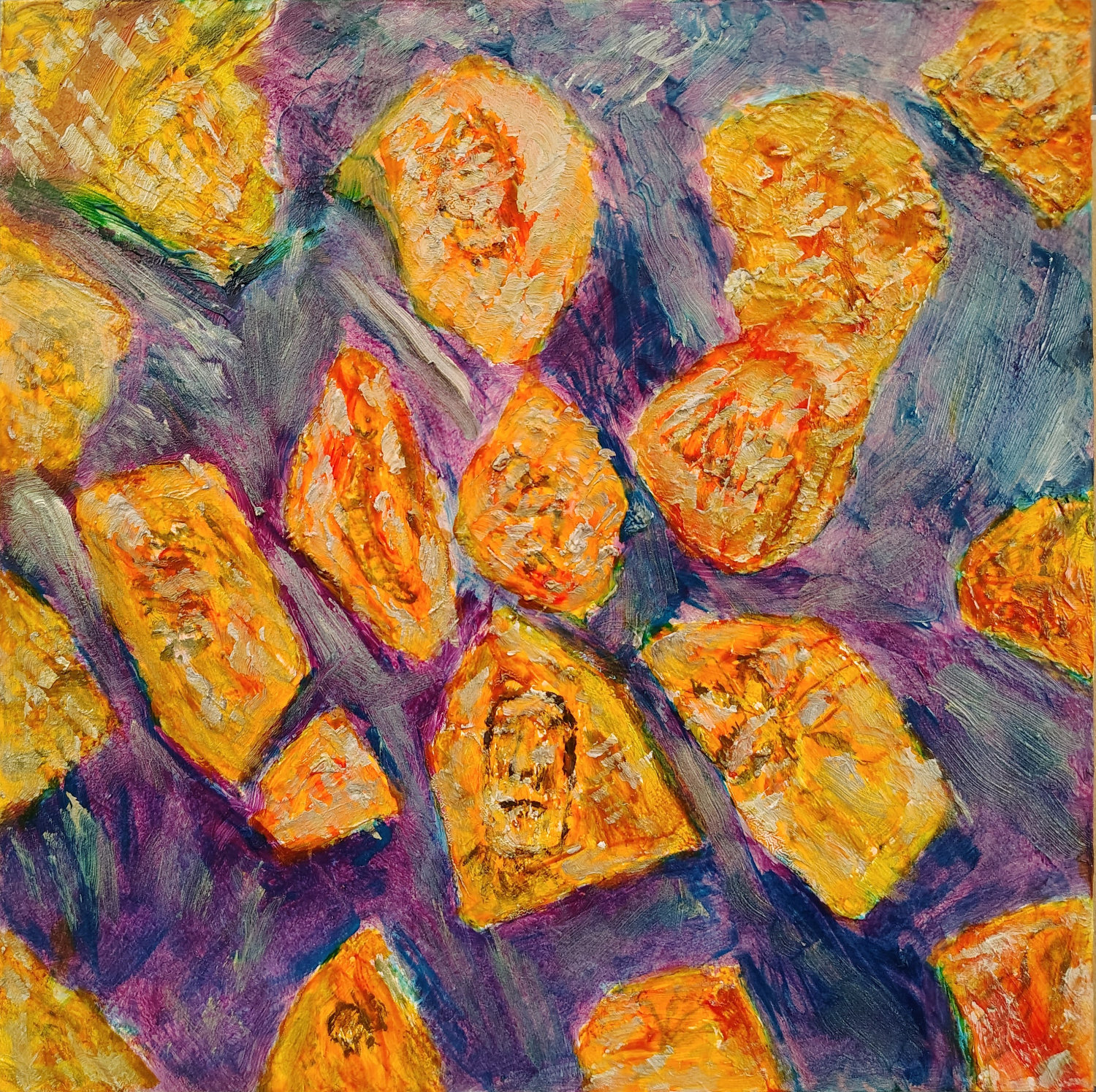
The Ediacaran Past; Oil on Panel (click to enlarge)
I’ve recently explored painting inspired by fossil traces of remote geologic periods. The first three of this series cover these ancient spans:
Ediacaran; 635–538.8 Mya, during which life forms arose that have no obvious connection with the evolutionary tree that followed.
Cambrian, 538.8 Mya – 486.85 Mya, during which complex life forms evolved, spurred by a biological “arms race”, to eat rather than be eaten.
Quaternary, 2 .6 Mya to present, during which Man took over the planet, with apparent intent to run it into the ground.
This is abstraction inspired by fact, informed by long hours of curiosity with the strange visualizations provided by the optical microscope of rock samples, in this case a Leitz Orthoplan equipped with epi-illumination.
If you stare long enough, you may find representations of homo in all the paintings, justified as the viewpoint presence. Remember that all that ever was lies under our feet; our borrowed atoms the substance of an unknown future.
The evolution of this nascent conflict is a little odd. Though in decline, classical war is preceded by the development of pretext, with complaints that may be true though frequently false, followed by negotiations that seek to convince some audience of the reasonableness of the plaintiff, followed or accompanied by mobilization, and finally, the casus belli that leads directly to hostilities.
This time, Clausewitz does a headstand: Politics is nothing but the continuation of war with other means, at least now, with Venezuela. (For reference, Clausewitz actually wrote (Springer Nature Link) War is nothing but the continuation of policy with other means’ (Clausewitz, 1993:77).
What some might have hoped would be a splendid little war looks now more like an old fashioned election, with the likker and money flowing freely. Trump wants to buy out the Bolivarian generals, but as they have been bought by the cartels, they have to be bought again. And as the cartels may actually have greater resources for that kind of disbursement than the CIA, so the Trump team’s offer must be two-edged, and one that they can’t refuse: Take a few million with a clear path to a pardon, or a one-way bus ticket to CECOT or Supermax.
This is likely why the (NBC) pardoning of former Honduras President Juan Orlando Hernández has a specific audience, as does the show of military hardware. Meanwhile, Maduro vanished for a while, probably on an old-fashioned stump tour for the same constituency.
With the scrutiny of Senate and House Armed Services committees of the “double-tap” boat strike, and the absence of actual U.S. mobilization, Maduro senses weakness. This highlights an ageless truth about bluffing. The little guy can get away with it, unless the big guy has an institutionalized appetite for war. Still, we cannot discount the possibility that he will wake up with a horse in his bed.
Does Maduro breed horses?